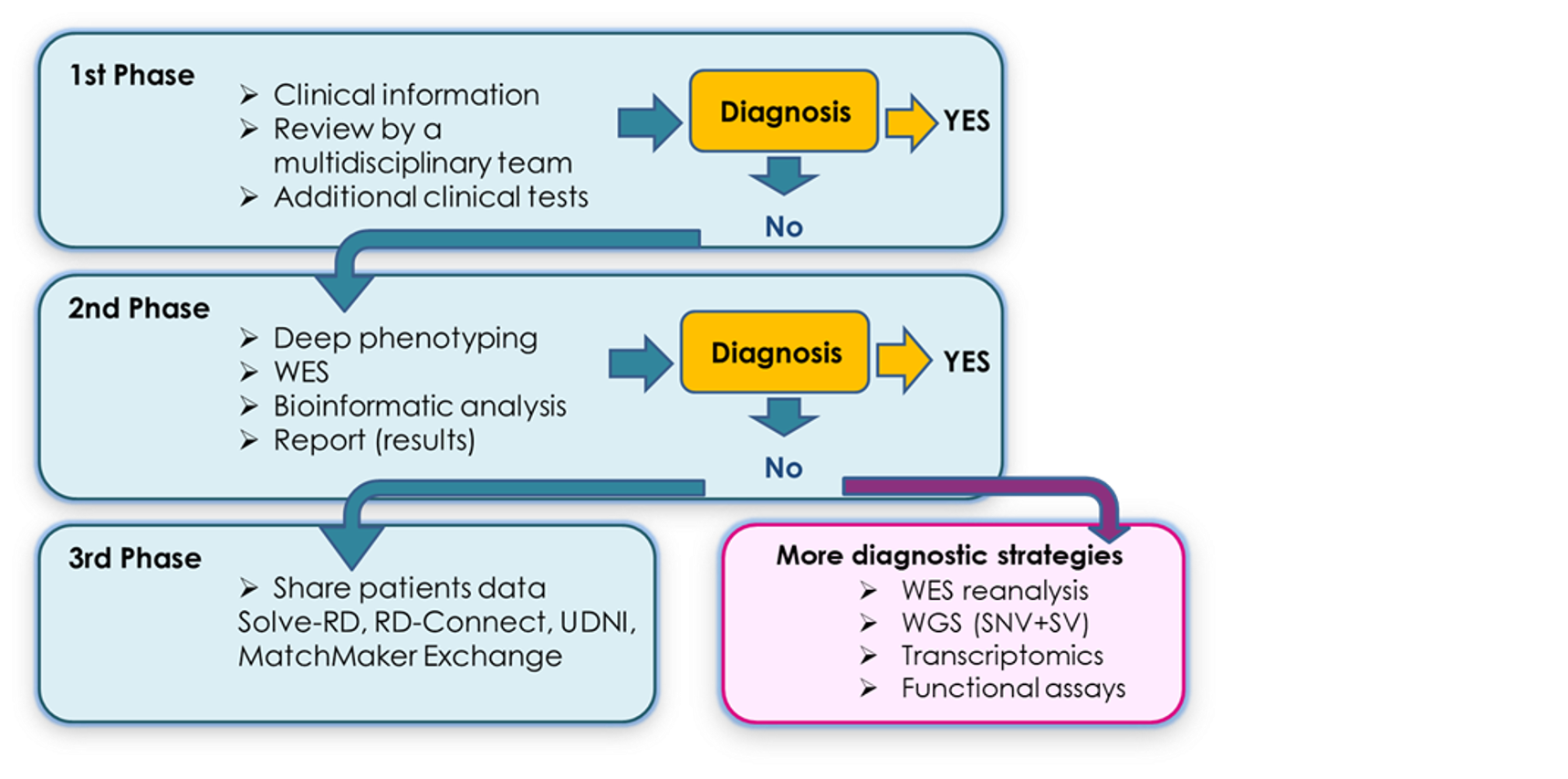
The SpainUDP Program is structured into three main phases that systematically guide the diagnostic process, aiming to provide answers for patients with rare diseases that have not yet been identified. These phases allow each case to be addressed comprehensively, combining clinical evaluation, advanced genetic studies, and interdisciplinary collaboration. Through this progressive approach, the program maximizes the chances of reaching an accurate diagnosis, even in highly complex medical situations.
During the first phase, the patient’s clinical reports are reviewed by a team of experts. If deemed necessary, the patient may be examined in person at the Hospital Universitario Puerta de Hierro in Madrid. If a diagnosis is not achieved at this stage, the case advances to the next phase.
The second phase involves a combined analysis of the patient’s genetic and phenotypic information, along with blood samples from the patient and their parents or siblings. This data is used to create a detailed report that explores potential links between genetic variants and known symptoms or diseases. If a causal relationship is identified, a diagnosis is provided. If not, the case moves to the third phase.
In the third phase, the patient’s data is securely shared through international research networks such as RD-Connect, PhenomeCentral, or MatchMaker Exchange. This global collaboration can help identify similar cases and move closer to a diagnosis.